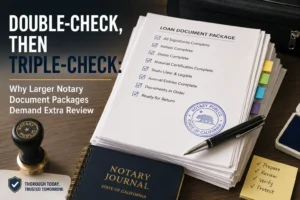
Double Check then Triple Check – Larger sets of documents need even more thorough review
By Carin Guertin
•
June 12, 2024
•
13 min to read
How to Review Large Notary Document Packages
Loan signings, trust documents, and other large notary document packages require an extra-diligent notary public.
A single acknowledgment may only involve a few minutes of work. A loan signing or estate planning package can involve dozens—or sometimes hundreds—of pages, multiple signatures, several notarial acts, and more opportunities for something small to go wrong.
More paperwork does not change the notary laws. It simply gives human error more places to hide.
A missing signature, an incomplete certificate, a skipped journal entry, or a blurry seal can delay recording, hold up funding, create additional expenses, and result in an unhappy call from the title company or law office. That is why reviewing large notary document packages should be treated as part of the appointment, not as an optional final glance on the way out the door.
Key Takeaways
When handling a large loan, trust, or estate planning package, a California notary should:
- Review all instructions before meeting the signers
- Keep the documents in their original order throughout the appointment
- Verify every required signature, initial, and witness line
- Complete each notarial certificate and journal entry carefully
- Obtain a thumbprint when California law requires one
- Confirm every seal impression is clear and reproducible
- Never guess how a document or certificate should be corrected
- Perform a final review before scanbacks, shipping, or hand delivery
This is administrative and notarial review — not legal review. A notary should not interpret documents, choose legal forms, advise signers, or determine a signer’s representative capacity.
Why Large Notary Document Packages Require Extra Review
Loan and trust signings can test even an experienced notary public. The documents may involve significant financial transactions, property rights, healthcare decisions, powers of attorney, or instructions concerning a family’s estate.
Loan signings are frequently tied to funding and recording deadlines. Estate planning appointments may involve several family members, multiple documents, witnesses, and signers who are understandably taking their time with important decisions.
A larger package may include:
- Deeds of trust
- Grant deeds or quitclaim deeds
- Powers of attorney
- Affidavits
- Occupancy statements
- Signature affidavits
- Trust certifications
- Healthcare directives
- Assignment documents
- Lender disclosures
- Escrow instructions
- Documents that require witnesses but not notarization
- Documents that require signatures or initials but no notarial act
Not every page requires notarization, and not every blank line is necessarily an error. The notary’s job is to follow the provided instructions, perform each requested notarial act correctly, and confirm that the package has been signed as directed.
Notaries interested in handling real estate assignments should also understand the difference between a notary public and a notary signing agent. A signing agent performs the duties of a commissioned notary while also managing the administrative requirements of a loan-signing appointment.
Prepare Before the Appointment Begins
The final review becomes much easier when the notary prepares in advance of sitting down with the signers.
Start by reading every instruction supplied by the lender, escrow officer, title company, signing service, or law office. Do not assume the instructions will be the same as those from a previous appointment. Two packages from the same company can contain different documents, return procedures, or signing requirements.
Before leaving for the appointment, confirm:
- The signer’s name and appointment location
- Whether more than one signer will be present
- Whether witnesses are required and who is responsible for providing them
- Whether the package contains a borrower’s copy
- Whether documents must be printed on letter, legal, or mixed-size paper
- Whether scanbacks are required before shipping
- The return shipping method and deadline
- Whether any special signature format has been requested
- Which documents appear to contain notarial certificates
- Who should be contacted if the signer has a document-related question
Bring Backup Notary Supplies
A large signing is not the ideal time to discover that a pen has stopped working or the seal is running low on ink.
A prepared notary kit should include:
- Several blue and black pens
- A current sequential notary journal
- A thumbprint pad
- The official notary seal
- Approved seal refill ink
- Loose acknowledgment and jurat certificates
- Removable page flags or tabs
- A secure document bag
- Shipping supplies when required
Notaries who need to replace or restock these items can find California-compliant notary supplies, journals, stamps, and certificate forms.
Loose certificates should not be attached simply because one happens to be available. The signer or document recipient must identify the notarial act required when the document does not contain appropriate wording. The notary may explain the general difference between an acknowledgment and a jurat, but should not choose the act on the signer’s behalf.
Set Expectations at the Signing Table
At the beginning of the appointment, explain that you will review the package after the signing is complete.
A simple statement works well:
“Once we finish signing, I’ll take a few minutes to review the package and make sure all required signatures, initials, certificates, and seals are complete.”
This helps prevent the signers from packing up immediately or assuming the appointment is finished as soon as the final page has been signed.
Keep the documents in their original order. Removing pages and creating several stacks may feel efficient at first, but it can quickly turn a well-organized package into a paper puzzle nobody asked for.
Present one document at a time and clearly indicate where the signer has been instructed to sign, initial, or date. The notary may identify the general title of a document and point to information printed on the page, but should not interpret legal language or advise the signer about whether the document is beneficial.
When a signer asks a legal or loan-specific question, pause the signing and contact the appropriate lender, escrow officer, title representative, or attorney.
Follow California Notary Requirements Throughout the Package
A package review should confirm more than the presence of signatures. The notary must also verify that each notarial act complies with California law.
The current California Secretary of State Notary Public Handbook should be the primary authority when questions arise.
Confirm the Document Is Complete
A California notary may not notarize a document that is incomplete or clearly appears incomplete on its face.
This does not mean the notary must inspect or understand every legal provision. It means the notary should watch for obvious incompleteness, such as missing pages or unfilled spaces that appear essential to the document.
When uncertain, stop and contact the document recipient rather than guessing.
Complete the Correct Notarial Certificate
A notarial certificate should be completed fully at the time the notary signs and affixes the seal.
Check:
- The state and county venue
- The date of the notarial act
- The signer’s name
- The required statutory wording
- The notary’s signature
- The seal placement
- Any attached-certificate information identifying the document
California notaries certify the identity of the individual who signed. They do not certify the truthfulness of the document or determine that the signer legally holds a particular representative capacity.
For example, the documents may instruct someone to sign as “Jane Smith, Trustee.” The notary can confirm that the signature follows the written instructions, but the notarial certificate should not independently certify that Jane is legally authorized to serve as trustee.
Complete the Journal Record
California requires every notary public to maintain one active sequential journal and record all official acts.
Journal information includes the date, time, and type of act, the character of the instrument, the signer’s signature, identification information, and the notarial fee. Deeds, deeds of trust, powers of attorney, and other documents affecting real property also require the signer’s thumbprint in the journal.
A package containing several notarized documents may require several clearly identified journal records. Writing only “loan documents” may not adequately identify the character of every instrument.
For a more detailed explanation, review the guide to California notarial journal management.
Inspect Every Seal Impression
California requires an official seal to be photographically reproducible. The impression should be clear, complete, and positioned away from signatures and printed wording.
A document recorder may reject a document when the seal is illegible or improperly placed. One blurry stamp inside a large package can create a surprisingly large headache, so inspect every impression before moving to the next document.
Use a Two-Pass Review System
Trying to inspect everything at once makes it easier to overlook something. A two-pass system separates signer-related requirements from the notary’s official work.
First Pass: Review the Signer’s Work
During the first pass, look for:
- Missing signatures
- Missing initials
- Missing dates
- Signatures placed on the wrong line
- Required witness signatures
- Signature formatting specified in the instructions
- Pages that appear to have been skipped
- Corrections that have not been completed according to instructions
Pay special attention to documents with several signature locations. A signer may sign correctly on the first page and miss a second signature several pages later.
Do not assume that every empty line must be completed. Some forms contain optional sections or lines intended for another party. When something is unclear, consult the written instructions or contact the hiring party.
Second Pass: Review the Notarial Work
During the second pass, check:
- Each certificate is attached to the correct document
- The venue is accurate
- The date matches the actual date of appearance
- Every signer’s name is entered correctly
- The notary signature is present
- The seal is complete and legible
- No seal covers printed text or a signature
- Each notarial act is recorded in the journal
- Required thumbprints have been obtained
- No certificate contains an unfilled space that should have been completed
The second pass should be slow and deliberate. It is much easier to correct a problem while the signer is still sitting across the table than after the package has travelled halfway across California.
How to Handle Corrections Properly
There is no universal rule stating that every correction should be initialed and dated. The correct procedure depends on the document and the instructions of the lender, title company, attorney, or receiving agency.
When a signer makes an error on a document:
- Stop before making any additional marks.
- Review the package instructions.
- Contact the hiring party when the procedure is unclear.
- Have the signer correct only as instructed.
- Never alter the legal terms of the document yourself.
Corrections to the underlying document are different from corrections to a completed notarial act.
California law does not provide a procedure for correcting a notarial act after it has been completed. If an error is discovered after completion, the signature must be notarized again. The signer must appear again, all normal notarization requirements must be followed, a new certificate must be completed with the new date, and a new journal entry must be made.
This is one of the strongest reasons to review the certificate before the signer leaves.
Triple-Check the Package Before the Handoff
The first review checks the signer’s work. The second checks the notary’s work. The third confirms that the completed package is ready to leave your possession.
Before shipping, scanning, or hand-delivering the documents:
- Confirm the entire package is present.
- Return all documents to the required order.
- Separate the signer’s copy from the return package.
- Complete any required scanbacks.
- Verify that scanned pages are readable.
- Use the correct return label and shipping envelope.
- Record the tracking number.
- Follow any instructions requiring approval before shipment.
- Keep the documents secure until they are handed to the carrier or recipient.
Do not place loan or estate documents in an unattended vehicle, leave them visible in a public area, or hand them to someone who has not been authorized to receive them.
The assignment is not truly complete until the package has been returned in the manner requested.
A Real-World Example
Imagine a refinance package containing 120 pages.
The borrowers sign every page presented to them, and everything appears to go smoothly. During the first review, the notary finds that one borrower missed initials on an occupancy form and both borrowers overlooked a second signature line on an affidavit.
During the second review, the notary notices that the deed of trust journal entry is missing a thumbprint and one acknowledgment seal is too faint to reproduce clearly.
All four issues can be corrected while the borrowers are still present.
Without that final review, the package might have been returned incomplete, delaying funding and requiring another appointment. Five extra minutes at the table can prevent hours—or days—of follow-up work.
Frequently Asked Questions
Why do large notary document packages need more review than a single notarization?
Large packages contain more signature lines, initials, certificates, and journal records than a typical acknowledgment or jurat. Each additional requirement is another place where a page or notarial step can be missed, so the review needs to scale with the size of the package.
How many times should a notary review a loan or trust package, and what does each pass check?
At minimum, two passes: one for the signer’s work (signatures, initials, dates, witness lines) and one for the notary’s own work (certificates, journal entries, thumbprints, seals). A third, final check should confirm the package is complete, in order, and ready for scanning or shipping before it leaves your hands.
Who decides which notarial act a document requires?
The signer, document preparer, attorney, or receiving agency — not the notary. A notary can describe the general difference between an acknowledgment and a jurat, but shouldn’t choose the act on the signer’s behalf.
Does every document in a loan package need notarization?
No. Many loan documents only require a signature or initials and no notarial act at all. Follow the package instructions and only perform the notarizations that are actually requested.
What should a notary do when package instructions conflict with California law?
California notary law takes priority. Pause the appointment, explain that the requested action can’t be performed as instructed, and contact the hiring party to work out a lawful alternative.
Are thumbprints required for trust documents?
It depends on the specific document, not on whether it’s part of a trust package. California requires a journal thumbprint for deeds, deeds of trust, powers of attorney, and other documents affecting real property — regardless of which package they’re in.
What should a notary do with a blurry or unreadable seal?
Fix it before the appointment ends. The seal must stay clear and photographically reproducible. Follow lawful correction procedures — typically completing a clean certificate — while the signer is still present, rather than shipping the package with a defective impression.
Can a notary explain the terms of a loan or trust?
No. A non-attorney notary shouldn’t interpret provisions, explain legal consequences, or advise on whether a signer should proceed. Questions about rates, terms, or legal effect should go to the lender, escrow officer, document preparer, or attorney.
Conclusion: Careful Review Protects Everyone
Reviewing large notary document packages is not unnecessary extra work. It is part of providing a dependable, professional service.
A disciplined double-check protects the signer, the document recipient, and the notary. A final triple-check before handoff helps ensure the package is complete, secure, and ready for its next destination.
The most successful notaries are not necessarily the ones who finish appointments fastest. They are the ones who consistently return accurate packages without missing signatures, incomplete certificates, skipped journal information, or unreadable seals.
Preparing for your California commission? Strengthen your knowledge of certificates, journal requirements, identification rules, and prohibited acts with the California Notary Practice Test.
 Free shipping on supplies orders over $70.00