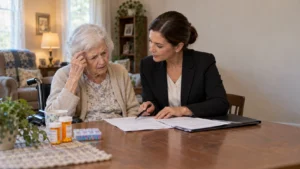
Cognitive Challenges for Signers: What California Notaries Should Watch For
By Carin Guertin
•
September 17, 2026
•
15 min to read
The Cali Notary – A Day in the Life
Most requests for mobile notary services are fairly routine. A repeat customer may already know what information I need, the signer has acceptable identification ready, and I have a good idea of how much time to allow for the appointment. Every once in a while, though, I get a call that sounds simple at first but quickly raises a few more questions.
It might be someone asking me to “just drive over” to their parent’s house because there are some bank papers that need to be notarized. The caller may not know exactly what the documents are, how many signatures are involved, what type of identification the signer has, or even whether the signer knows that a notary appointment has been arranged. None of these things automatically mean there is a problem, but they do mean I need a little more information before I can properly schedule the signing.
When cognitive challenges may be involved, a California notary has to find the right balance. We are not doctors, and our role is not to conduct a medical competency evaluation. Our responsibility is to remain impartial, follow California notary law, communicate sufficiently with the signer, and make sure the requirements of the particular notarial act can actually be completed.
Quick Summary
When a signer appears confused, hesitant, or heavily dependent on family members or caregivers, a California notary should slow the appointment down and make sure the required notarial procedure can be completed correctly. For an acknowledgment, the signer must personally appear before the notary and acknowledge executing the document. For a jurat, the signer must personally appear, sign in the notary’s presence, and take an oath or affirmation. The notary must also establish the signer’s identity using satisfactory evidence permitted under California law. The notary’s job is not to diagnose cognitive impairment, but to determine whether the requirements of the requested notarial act can properly be completed.
Sometimes the First Red Flag Comes During the Phone Call
One of the reasons I ask several questions when scheduling a mobile appointment is that the initial caller is not always the person who will be signing. A son, daughter, caregiver, attorney’s office, or another family member may be arranging everything on the signer’s behalf. That is perfectly normal, but I still need enough information to know what I am walking into.
The basic “who, what, when, where and why” can prevent a wasted trip for everyone involved. I want to know who will be signing, what type of documents are involved, approximately how many signatures need notarization, where the appointment will take place, how soon the documents are needed, and whether the signer has identification that may be used for the notarization.
I also like to know whether the signer is expecting me. If someone tells me, “My mother doesn’t really know about the appointment yet, but just come over and we’ll explain it when you get here,” that does not automatically mean the appointment cannot take place. It does tell me that I will probably need to take some extra time once I arrive and communicate directly with the signer before proceeding.
Asking these questions beforehand is not about judging the signer. It is simply good mobile notary practice, particularly when an appointment involves someone who is elderly, ill, recovering from surgery, or living in a care facility.
The Signing Location Can Require Additional Care
Mobile notary appointments are ideal for people who have difficulty travelling, and that certainly does not apply only to older adults. Someone may be recovering from surgery, dealing with an injury, experiencing mobility problems, or simply be more comfortable completing the appointment at home.
Hospitals, rehabilitation centers, nursing homes, and assisted living facilities can be a little different from a standard home signing. There may be a visitor check-in process, medical staff coming and going, family members in the room, and additional time needed to locate identification or get the signer comfortably positioned to complete the documents.
Patience is especially important in these situations. A signer may need more time to hear a question, read something, locate their glasses, or physically sign their name. None of those things should automatically be interpreted as a cognitive problem.
The extra setup time also gives me an opportunity to have a normal conversation with the signer. I can make sure we can communicate sufficiently for the required notarial act and get a sense of whether other people in the room are simply being helpful or are preventing the signer from responding directly.
What Does California Require From the Signer?
California notaries must follow the same basic legal requirements regardless of the signer’s age or physical condition. For common notarial acts such as acknowledgments and jurats, the signer must personally appear before the notary. Under current California law, appearing by video call does not satisfy this personal appearance requirement.
Identity must also be established using satisfactory evidence permitted under California law. An acceptable identification document is commonly used, although California also provides specific procedures involving credible witnesses under qualifying circumstances.
Credible witnesses should not simply be treated as an easy substitute because someone cannot find their identification. California law places specific conditions on their use. For example, the circumstances must make it very difficult or impossible for the signer to obtain another permitted form of identification, and the signer must not possess one of the identification documents authorized by law. Additional requirements apply depending on whether one or two credible witnesses are used.
The particular notarial act also matters. For an acknowledgment, the signer personally appears, identity is established, and the signer acknowledges executing the document. The signer does not have to sign the document in the notary’s presence.
For a jurat, the signer personally appears, signs the document in the notary’s presence, and takes an oath or affirmation.
Anyone learning the steps to become a California notary should understand this distinction because acknowledgments and jurats have different requirements even though both require personal appearance.
For official information on California notarial procedures, always refer to the current California Secretary of State Notary Public Handbook.
What Should Make a Notary Slow Down?
There is no simple checklist that tells a notary whether someone is mentally capable of signing a document, nor should a notary create their own medical competency test. Forgetting a date, taking a while to answer a question, or needing something repeated does not automatically mean a person cannot participate in a notarization.
People get nervous. They get tired. Medication can make someone sleepy. Hearing problems can make a person appear confused when they simply did not hear the question. Legal documents can also be intimidating, particularly for someone who has never dealt with them before.
There are, however, situations where I would slow the appointment down and pay closer attention. The signer may seem genuinely surprised that I have arrived, repeatedly say they do not know why a notarization is taking place, or constantly look to someone else before responding. A signer may also tell me they do not want to continue, or a family member may repeatedly interrupt and try to change the signer’s responses.
These observations are not a medical diagnosis or a legal competency determination. They are practical reasons to take more time and make sure I can perform the requested notarial act correctly.
Speak to the Signer, Not the Entire Room
One of the most useful things a notary can do in a crowded signing situation is make sure the necessary communication is actually taking place with the signer.
This can become surprisingly difficult when a whole team of people is present. The notary asks the signer a question and the daughter answers. Another question is asked and the caregiver responds. Someone points to a signature line while another person starts explaining what the document means.
Most of the time, people are simply trying to help. The problem is that the notary still needs to obtain the required acknowledgment, oath, or affirmation from the signer rather than allowing another person to provide those responses on the signer’s behalf.
When appropriate, I may ask everyone else to give us a few minutes. I do not need to interrogate the signer or start asking a series of medical-style questions. I simply need to communicate sufficiently with the signer to perform my notarial duties.
Those few minutes can make a big difference. Sometimes a signer communicates perfectly well as soon as everyone else stops answering for them.
Be Aware of Pressure From Family Members or Caregivers
Family members may have very good reasons for wanting documents completed quickly. There may be an attorney waiting for paperwork, a financial deadline approaching, or several relatives who have travelled a long way to be there.
None of that changes the notary’s responsibilities.
If a signer tells me they do not want to proceed with the notarization, I am not going to continue simply because someone else says, “Mom, we already talked about this. Just do it.” Likewise, if I ask the signer a question and someone else continually tries to provide the necessary responses, I am going to slow things down.
This does not mean every family member should be treated with suspicion. Most are genuinely trying to help. It simply means that the notary needs to remain impartial and make sure the requirements of the notarial act can be completed with the signer.
Physical Limitations Are Not the Same as Cognitive Challenges
Another mistake notaries should avoid is assuming that difficulty physically signing a document means the person does not understand what is happening.
An older signer may have arthritis. Someone recovering from a stroke may have difficulty controlling a pen. A person with Parkinson’s disease or another physical condition may have a shaky or unusual signature while being completely capable of participating in the notarization.
California also provides a procedure for a person who cannot write their name to sign by mark. When a signature by mark is used, California has specific requirements, including witnesses to the mark and an entry of the signer’s mark in the notary’s journal. The exact procedure should be followed carefully.
The important point is that physical limitations and cognitive challenges are not the same thing. A notary should not make assumptions about someone’s ability based simply on age, appearance, disability, or the way they physically sign their name.
This is one reason proper training matters. Anyone preparing for a commission should understand identification requirements, acknowledgments, jurats, journal entries, and other common procedures before beginning to handle real appointments. Taking a California Notary Practice Test can help reinforce these rules while preparing for the state exam.
What If the Signer Starts Asking for Legal Advice?
This is another situation that can arise during appointments involving powers of attorney, estate planning documents, financial paperwork, and similar documents.
A signer may suddenly ask, “Should I sign this?” or “Does this mean my daughter will control my bank account?” Those may be perfectly reasonable questions, but they are not questions I can answer simply because I am the notary.
California’s required acknowledgment and jurat wording makes an important distinction. The notary verifies the identity of the person who signed the document; the notary is not verifying the truthfulness, accuracy, or validity of the document itself.
A notary can explain the notarial procedure being performed and what is required for that procedure. A notary should not interpret the legal effect of a document or tell someone whether signing it is in their best interest. If the signer needs legal advice before deciding whether to proceed, they should speak with a qualified attorney or another appropriate professional.
The California Secretary of State provides additional information about the required wording for California acknowledgments.
When Is It Appropriate to Stop the Notarization?
There are times when the most professional decision is simply not to complete the notarization at that moment.
The important thing is to focus on the actual problem with the notarial act rather than making statements about the signer’s mental condition. A notary does not need to announce that someone is “incompetent” or try to diagnose why the signer is having difficulty.
Perhaps satisfactory evidence of identity cannot be established. For an acknowledgment, perhaps the signer will not acknowledge executing the document. For a jurat, perhaps the signer cannot or will not sign in the notary’s presence or take the required oath or affirmation. The signer may also clearly indicate that they do not want to proceed or may need legal advice before deciding what to do.
If the requirements of the requested notarial act cannot be satisfied, the notary should not complete the certificate simply because other people in the room want the transaction finished. Depending on the situation, the underlying issue may later be resolved and another appointment may be possible.
A Real-World Signing Scenario
Imagine arriving at an assisted living facility to notarize a document for an elderly gentleman. His daughter scheduled the appointment and is sitting beside him when you arrive.
You begin communicating with him about the notarization, but his daughter immediately responds on his behalf. You try again, and once more she answers before he gets a chance.
That does not automatically mean anything improper is happening. She may simply be accustomed to helping her father and may not realize that the notary needs to communicate with him sufficiently to complete the notarial act.
I would politely explain that I need to hear from the signer himself and, if appropriate, ask to speak with him without everyone answering for him. He may then communicate clearly and the appointment may continue without a problem.
If, on the other hand, I cannot obtain the acknowledgment or other response required for the particular notarial act, I would not simply accept the daughter’s response and move ahead with the notarization.
Situations like this are a good reminder that becoming a notary involves more than passing an exam. The law provides the foundation, but real appointments also require patience, professionalism, and good judgment.
Frequently Asked Questions
Does an elderly signer need a doctor’s letter before a document can be notarized?
California notary law does not generally require a doctor’s letter simply because a signer is elderly. The notary should follow the requirements of the notarial act and avoid making assumptions based on age. An attorney, financial institution, or another party involved in the underlying transaction could have separate requirements unrelated to the notarization.
Can someone with dementia have a document notarized?
A diagnosis by itself does not determine whether a particular notarial act can be completed. The notary should not conduct a medical competency evaluation. Instead, the notary should focus on whether the signer can personally participate and whether all requirements for the requested notarial act can be satisfied.
What if the signer cannot physically write a normal signature?
Physical difficulty signing does not automatically prevent notarization. California provides a signature-by-mark procedure for a person who cannot write their name. Specific witness and journal requirements apply, so the correct procedure must be followed.
What happens if the signer does not have acceptable identification?
California requires satisfactory evidence of identity for acknowledgments and jurats. Identification documents are commonly used, but California also permits credible witnesses under specific qualifying circumstances. Credible witnesses are not simply an automatic replacement for missing identification, and all applicable requirements must be followed.
Can a California notary explain what a power of attorney or other legal document means?
A notary should not provide legal advice simply because they hold a notary commission. If the signer needs advice about the legal effect of a document or whether they should sign it, they should speak with a qualified attorney or another appropriate professional.
Conclusion
Appointments involving cognitive challenges for signers may require a little more patience and awareness, but the notary’s basic role remains the same. We are there to perform the requested notarial act properly, remain impartial, establish identity as required, and communicate sufficiently with the signer.
Not every slow response is a red flag, and not every elderly or medically fragile signer has cognitive difficulties. Sometimes a person simply needs more time, a quieter room, or an opportunity to respond without several other people speaking for them.
When something does not feel routine, slow down, gather the information you need, and focus on the requirements of the notarization. That approach helps protect the signer while also helping the notary perform their duties correctly and professionally.
If you are preparing to become a California notary, understanding these real-world situations is just as important as memorizing the rules for the state exam. Start with our California-approved 6-hour notary course, review the steps to become a California notary, and use our California Notary Practice Test to strengthen your knowledge before taking the exam.
 Free shipping on supplies orders over $70.00