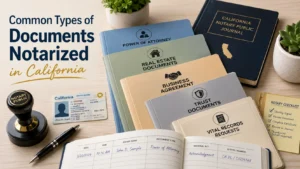
Common Types of Documents Notarized in California
By Carin Guertin
•
October 20, 2025
•
9 min to read
Notaries public in California are asked to notarize many different types of documents, from business agreements and legal forms to real estate paperwork, powers of attorney, and requests for personal records.
While a notary’s role is not to give legal advice or explain the contents of a document, understanding the types of documents commonly notarized can help new notaries feel better prepared for real-world appointments.
Below are several examples of documents that are typically notarized in California, along with practical tips for handling each type of signing professionally and carefully.
Quick Summary
Common documents notarized in California include powers of attorney, real estate documents, trust documents, business agreements, adoption forms, bills of sale, transfer forms, and vital records request forms. A California notary public does not verify whether the document is legally correct. The notary’s role is to identify the signer, complete the proper notarial certificate, record the notarization in the journal, and follow California notary law.
Key Takeaways
- California notaries commonly handle business, legal, real estate, personal, and property-related documents.
- The notary does not prepare documents, choose documents, or give legal advice.
- Some documents, such as powers of attorney and certain real estate documents, require a thumbprint in the notary journal.
- Foreign-language documents may not be notarized if the notary and signer cannot communicate directly in a common language.
- Every notarization should be recorded clearly and completely in the notary journal.
Corporate Office Documents
Businesses of all sizes need the services of notaries public for a wide range of documents. Corporate notarizations may involve officers, directors, employees, vendors, lenders, or outside parties, so it is important for the notary to understand who will be signing, where the signing will take place, and what identification will be required.
For newer notaries, reviewing the steps to become a notary can also help reinforce the responsibilities involved before handling more complex business appointments.
Here are some examples of corporate documents that may require notarization:
Articles of Incorporation: When a business is being formed, notaries may be asked to notarize Articles of Incorporation or related corporate documents. These documents may include the names of the corporation’s initial directors or officers. All required signers may be present at the same meeting, or the documents may need to be signed over several appointments. It is always a good idea to ask the contact person how many signers will be present and remind them that each signer must have valid photo identification.
Security Agreements: A Security Agreement is often used when a business secures a loan from a financial institution or another lender. Corporate officers may sign this type of document to confirm that certain company-owned assets or collateral will be used to secure the loan.
Contracts: Businesses may need to have contracts with vendors, subcontractors, consultants, or service providers notarized to verify the signer’s identity and formalize the agreement. In many cases, only one party’s signature needs to be notarized, and the appointment may take place at a corporate office, job site, or another agreed location.
Transfer Forms: When a business sells, assigns, or transfers equipment, vehicles, inventory, or other assets to another company or individual, a Transfer Form may be required to be notarized. These signings can involve multiple parties, different locations, and several documents, so confirming the appointment details in advance can help avoid delays.
Documents Commonly Notarized for Legal Firms
Law firms often need documents notarized for clients, claimants, witnesses, and other parties involved in legal matters. Many firms have paralegals or staff members who are commissioned notaries public, but outside mobile notaries are also commonly needed when clients cannot come to the office or when multiple signers are involved.
Powers of Attorney: A Power of Attorney allows one person to appoint another to act on their behalf for financial, medical, or legal matters. In California, a right thumbprint is generally required in the notary journal when notarizing a power of attorney. A Power of Attorney is also one of the few official documents that a California notary public may certify as a copy.
Retainer Agreements: A retainer agreement secures an attorney’s services for legal representation. In some cases, a client’s signature may be notarized to help verify identity and support the agreement’s enforceability.
Trust Documents: Trust document packages can be lengthy and may include several documents requiring notarization. These may include trust agreements, grant deeds, trustee powers, powers of attorney, and advance health care directives. Appointments for these signings often require extra time, so it is wise to ask the law office or signer how many documents and signers will be involved before the appointment.
Personal and Property-Related Documents
Personal and property-related notarizations can be among the most varied appointments a notary handles. The general public needs notarized documents for many different reasons, and signers may not always understand what a notary can and cannot do.
The notary’s role is to verify identity, complete the appropriate notarial act, and maintain a proper journal entry. The notary should not give legal advice, choose the type of notarization for the signer, or explain the legal effect of the document.
Because these appointments can involve many different document types, accurate recordkeeping is especially important. New and experienced notaries should understand proper notarial journal management so each entry is complete, clear, and compliant with California requirements.
Adoption Documents: In California, adoption-related documents, such as consent forms, waivers, and other paperwork, may require notarization. These documents are often sensitive, so notaries should be patient, professional, and careful when completing the notarization.
Bills of Sale: For private sales involving vehicles, equipment, or other high-value items, a Bill of Sale may be notarized to deter fraud and verify the signer’s identity. The notary should review the notarial certificate, identify the signer, and record the required details in the journal.
Out-of-State and Foreign Documents: California’s diverse population may occasionally need documents from another state or country notarized. Notaries should take extra care to make sure the notarial certificate they complete complies with California law. Documents written in a foreign language may be notarized as long as the notary and signer can communicate directly in a common language and the notary can properly complete the notarial certificate.
Real Estate Transactions: Real estate and loan signing appointments may involve multiple notarizations per signer. Common documents can include a Deed of Trust, Name/AKA Affidavit, Trust Certification, Corrective Deed, Affidavit of No Mortgage, Occupancy/Owner’s Affidavit, Marital Status Affidavit, and Disbursement Proceeds Instructions. These appointments often take 45 minutes to an hour or longer, depending on the number of documents and signers involved.
Vital Records Requests: When someone requests a certified copy of a birth, death, or marriage certificate, they may need to complete an application issued by the county where the event occurred. In many cases, the requester’s signature on the application must be notarized before the request can be processed.
What California Notaries Should Watch For
Some documents may look routine, but notaries should never assume the appointment will be simple. A signer may arrive with the wrong identification, the document may lack a notarial certificate, or the signer may ask the notary to explain which notarial act is required. In these situations, the notary must stay within the limits of California notary law.
A California notary may identify the signer, complete the notarial certificate, and record the act in the notary journal. However, the notary should not give legal advice, explain the legal effect of a document, or tell the signer whether an acknowledgment or jurat is required. If the document does not include a notarial certificate, the signer should be directed to the document issuer or another qualified professional for guidance.
Quick Tips for Handling Common Notarized Documents
- Confirm how many signers will be present before the appointment.
- Remind each signer to bring acceptable identification.
- Review the notarial certificate before completing the notarization.
- Do not give legal advice or choose the notarial act for the signer.
- Record each notarization clearly and completely in the notary journal.
- Allow extra time for real estate, trust, and multi-signer appointments.
FAQs About Common Documents Notarized in California
What documents are commonly notarized in California?
Common documents notarized in California include powers of attorney, real estate documents, trust documents, business agreements, adoption forms, bills of sale, transfer forms, and vital records request forms.
Does notarization make a document legal?
No. Notarization helps verify the signer’s identity and records the notarial act, but it does not prove that the document is legally valid, accurate, or enforceable.
Can a California notary notarize a foreign-language document?
Yes. A California notary may notarize a foreign-language document if the notary and signer can communicate directly in a common language and the notary can complete the notarial certificate properly.
Can a notary choose the type of notarization?
No. If a document does not include a notarial certificate, the signer or document issuer must decide whether an acknowledgment, jurat, or another notarial act is needed. The notary should not make that decision for the signer.
Do all notarized documents need to be recorded in the notary’s journal?
Yes. California notaries are required to record each notarial act in their sequential journal. The journal entry should be completed clearly and carefully at the time of the notarization.
What should a signer bring to a notarization?
The signer should bring the document, acceptable identification, and any required witnesses. The signer must also personally appear before the notary.
Conclusion
California notaries public handle a wide variety of documents, from corporate agreements and legal forms to personal records requests and real estate paperwork. Each appointment may be different, but the notary’s responsibilities remain the same: identify the signer, complete the proper notarial act, follow California notary law, and maintain a clear journal record.
For anyone preparing to become a California notary, learning the common types of documents that may require notarization is an important part of building confidence before taking on real-world appointments.
 Free shipping on supplies orders over $70.00