Notary True Crime: Fraud, Greed, and the Risks Notaries Face
By Carin Guertin
•
April 23, 2025
•
6 min to read
Exploitation, Fraud & Greed
The number one job of a notary public is to ensure that critical documents are signed by the legitimate parties named in those documents by checking identification documents issued by governmental agencies and recording all notarization transactions in the notarial journal. Each of these steps is prescribed by California law, which has some of the most comprehensive and strictest notarial laws in the country.
Each time a California notary public receives a new commission, an oath is taken, promising to uphold the laws of the state and the nation and to perform the duties of our office. However, some notaries deliberately renege on this commitment, while others may fall victim to shady characters intent on breaking the law. Exploiters and fraudsters look for easy targets, such as the elderly and inexperienced notaries, to prey on with their greedy schemes.
Today’s popularity of True Crime novels and TV shows is unparalleled, with some of those most dubious of transgressions involving a notary public somewhere in the story. Notarial laws are in place to deter crime and protect the notary. When these regulations are not followed to the letter, serious consequences can follow. But when a notary is diligent about their services, they might just have the evidence that can help crack cases of forgery, identity theft, and even murder.
Careful inspection of the identification presented, or thoughtful questioning about why a signer may lack identification and need to use credible witnesses, can help prevent a crime.
A stolen yacht (and worse) in Orange County, California
In November of 2004, Thomas and Jackie Hawks were eager to sell the yacht they had been living on for the past two years. They now wanted to buy a modest home on land closer to family, as they were very excited to be grandparents for the first time. They placed advertisements on their own to sell their beloved yacht, hoping to avoid the cost of a boat broker’s assistance. It was Skylar Deleon who called to express interest in purchasing the 55-ft Well Deserved.
Skylar Deleon, a troubled former child actor out on criminal probation, hatched a plan with his wife and some co-conspirators to steal the Hawks’s yacht that would help cover up some money laundering problems he was having at the time. On November 15, 2004, Deleon and some of his family and friends met up with the Hawks couple for a test sail on the yacht out of Newport Harbor. But that was the last day that anyone ever saw Tom & Jackie Hawks. The yacht returned to the harbor with a new owner, Skylar Deleon. On November 22, 2004, Deleon’s wife, Jennifer, contacted a notary public whom she had met at the extended stay hotel where the family was staying.
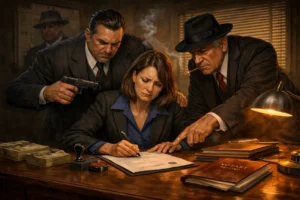
The notary public was asked to notarize a Power of Attorney from Thomas and Jackie Hawks, granting authority to Skylar Deleon and Bill of Sale for the yacht. However, the notary was asked to backdate the notarization to November 15, 2004, and she would be paid $2,000 in cash (well over her usual price for the service), with a promise of the opportunity to earn additional income when other documents were ready for notarization. Mistake #1 for this notary: the signers had not “personally appeared” before her and “proved on the basis of satisfactory evidence to be the person(s) whose names are subscribed” in the document, nor did they sign the notary’s journal and leave their right thumbprint as required for a Power of Attorney.
The notary questioned a friend she had in common with the Deleons as to why she was being asked to essentially break the law; she was informed that the people paying her for her services were “not to be messed with”. The notary public was then threatened with harm and worse against her and her family if she did not remain silent as to these fraudulent events. Scared for her life, the notary continued to cooperate with the criminals and even purposefully destroyed her seal and journal that contained the deceptive journal entries (mistake #2). These grievous lapses in the notary’s judgment had delayed the investigation into the disappearance of Thomas and Jackie Hawks.
After four or five aggressive police interrogations where the notary continued to stick to her false narrative, the notary was finally pressured enough to have her attorney make the call to law enforcement, asking to make her official statement and come clean on the events as they actually happened. And it was this statement – the admission that the notary had lied and performed these notarizations improperly – that assisted the Newport Beach Police Department in pressuring all of the other lying participants in this heinous crime. The notary then had to testify at the various murder trials about the wrongs that she committed in her sloppy notary work.
The (still) mysterious disappearance of Carole Baskin’s first husband
Another popular TV show, Tiger King, recently brought to light some strange notarial circumstances in Florida. The drama surrounds one of Tiger King’s “stars”, Carole Baskin, and her first husband, Don Lewis. Many who watched the show heard about Don Lewis’ disappearance shortly after he signed over a new Will and Power of Attorney that granted the bulk of his estate to his wife, Carole, and excluded the children from his first marriage.
Was it just an unfortunate timing that Don vanished? Or was there something more sinister behind the time frame of the document signing? The Will and Power of Attorney in question are now being examined for possible forgery, with continued pressure from Don Lewis’s children. And the notary herself now claims that, in addition to the possible forgery of Don Lewis’ signature, her own notarial signature was forged.
The notary in this case had made her living as a housekeeper for Carol and Don Lewis. When these events occurred in November of 1996, Florida did not require a formal education for its appointed notaries public. And the notary now claims that she didn’t even request her commission or notarial stamp. She also states that it was her employer at the time, Carole, who filled out the forms to request the stamp and had the stamp mailed to the business address (for Big Cat Rescue) rather than the notary’s home address – suspicious indeed.
Even in her advanced age, this notary has stuck by her story that she would not have notarized these questionable documents, in which people had not appeared before her. It just goes to show that the responsibilities of a notary are never to be taken lightly. Whatever state the notary public serves, a notary will always have the responsibility of serving as an impartial witness to deter fraud. By ensuring that personal appearance is accompanied by proper identification and willingness, the notary public performs an essential official duty.
 Free shipping on supplies orders over $70.00