How to Maintain Accurate Notary Journals and Records
By Notary Course Online
•
July 30, 2025
•
6 min to read
Maintaining an accurate notary journal is one of the most critical responsibilities of any practicing notary. A well-kept journal not only demonstrates professionalism and transparency but also serves as legal protection in the event of disputes, audits, or investigations.
Whether required by your state or not, notary journal maintenance is a best practice that every professional notary should prioritize. This blog will walk you through why record-keeping matters, what you should document, and how to keep your journal secure and legally compliant.
Why Notary Journal Maintenance Matters
Even if your state does not legally require you to keep a notary journal, maintaining one is strongly recommended. Here’s why:
- Legal Protection
A journal provides concrete evidence of your actions in case someone questions the legitimacy of a notarized document. If you’re ever summoned to court or investigated for misconduct, your journal can support your account of what happened.
- Transparency and Accountability
Journals help notaries stay organized and consistent, proving that due diligence was observed during every notarial act.
- State Requirements
Many states, including California, Texas, and Oregon, legally require notaries to maintain journals. Even in states where it’s optional, courts and attorneys often rely on notary records as critical evidence in legal matters.
Essential Components of a Notary Journal Entry
Each notarial act should be recorded with sufficient detail to establish a full record of the transaction. Here’s what your journal entry should typically include:
- Date and Time
Note the exact date and time the notarial act took place. This timestamp is crucial for establishing the order of transactions and for any future legal reference.
- Type of Notarial Act
Record whether you performed an acknowledgment, jurat, oath, affirmation, copy certification, or another type of notarial act.
- Document Title or Type
Include a brief but specific description of the document being notarized (e.g., “Power of Attorney,” “Lease Agreement,” “Affidavit”).
- Signer’s Information
Write down the signer’s full name, address, and contact information (if your state allows this). This helps in identifying the parties involved in the act.
- Method of Identification
Record how you identified the signer:
- Type of ID (e.g., driver’s license, passport)
- ID number (in some states, this is prohibited—check your local laws)
Alternatively, if you used credible witnesses, include their names, the identification document used, and their signatures.
- Signer’s Signature & Thumbprint if required
Your journal should have a designated space for the signer to sign and, if required for certain documents, a place for their right thumbprint. This affirms the signer’s appearance and willing participation in the notarial act.
- Fee Charged
Note the amount you charged, if any. This ensures transparency in your business practices and is often required by law.
- Additional Notes
Use this space to include observations such as language barriers, signers with disabilities, or if someone refused to sign. These notes can prove vital in court if the notarization is ever contested.
Best Practices for Notary Journal Maintenance
Creating accurate records is only one part of the process—how you maintain and store your journal is equally important. Here are several key best practices for record-keeping for notaries:
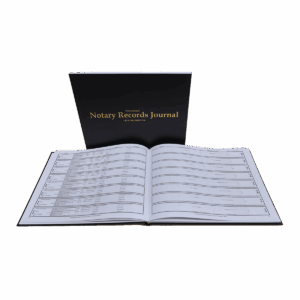
- Use a Bound Journal with Numbered Pages
A bound book with pre-numbered pages prevents unauthorized tampering or removal of entries. Spiral-bound notebooks or loose-leaf binders are not secure and often not legally acceptable.
- Make Entries in Ink
Always write in blue or black ink to prevent fading and maintain legibility. Never use pencils or erasable pens.
- Never Leave Blank Spaces
Every journal line must be completed. Draw a line through unused spaces to prevent someone from adding unauthorized information later.
- Only One Entry Per Transaction
Even if a document has multiple signers or copies, record each notarization as a separate entry to maintain clarity and legal integrity.
- Keep Journal Secure
When not in use, store your notary journal in a locked, secure location. This helps maintain the confidentiality of the signer’s personal information and protects you from liability.
Digital vs. Paper Notary Journals
Some states allow or even require notaries to keep electronic journals. These may be part of a Remote Online Notarization (RON) platform or maintained separately.
Advantages of Digital Journals:
- Easier to search and access
Limitations:
- May require specific state approval
- Security risks if not encrypted or backed up properly
- Some signers may prefer physical documentation
Important: Whether using a physical or digital journal, the same rules regarding accuracy, completeness, and confidentiality apply.
What to Do If You Make a Mistake
Everyone makes mistakes—but how you handle them in your notary journal can affect your legal standing.
To Correct an Error:
- Draw a single line through the incorrect entry
- Make the correction next to it
- Initial and date the correction
- Never use white-out or completely erase an entry
Always maintain journal integrity. Altering or destroying notary records can lead to criminal or civil penalties.
How Long Should You Keep Your Notary Journal?
The retention period varies by state, but a general rule of thumb is to retain your journal for at least 10 years. Some states require you to:
- Return the journal to the commissioning agency when your term ends
- Retain custody, even after leaving a notary position, if the journal contains personal records
Make sure you understand your state’s retention laws, especially before relocating, changing jobs, or retiring.
Tips for Organizing Multiple Journals
If you perform frequent notarizations, you may fill up a journal quickly. When transitioning to a new journal:
- Label each journal clearly (e.g., Journal #1, Journal #2)
- Log the date you started and completed each
- Store previous journals securely and separately from current ones
This system keeps your records easy to retrieve in case of legal inquiries or audits.
Final Thoughts
Your notary journal is more than just a notebook—it’s a legal record, a tool for protection, and a mark of professionalism. By maintaining accurate, secure, and detailed entries, you protect both yourself and the public from potential fraud, legal claims, and disputes.
If you’re looking to improve your record-keeping or need a refresher on journal compliance, consider enrolling in a state-approved course through NotaryCourseOnline.com. We offer expert-led training designed to help you maintain best practices, avoid costly mistakes, and excel as a trusted notarial professional.
FAQs
- Is keeping a notary journal mandatory in every state?
No, not all states require a journal, but it is highly recommended in all states. Some states, such as California and Texas, mandate the use of journals. Always check your state’s specific laws.
- Can I use a digital notary journal?
Yes, if your state allows it. Digital journals must meet security, encryption, and record-retention standards. Make sure you use an approved platform if you’re performing Remote Online Notarizations.
- What should I do if I lose my notary journal?
Immediately notify your state’s commissioning authority and document the circumstances. Depending on your state, you may need to file a police report or publish a notice of loss.
- Does NotaryCourseOnline.com teach how to maintain notary journals?
Absolutely! NotaryCourseOnline.com offers state-specific courses that include in-depth guidance on notary journal maintenance, legal compliance, and record-keeping best practices to help you stay confident and prepared.
 Free shipping on supplies orders over $70.00